Bulk sprouting & microgreen seed in 5, 10 and 20 lb bags | Ships from Cookeville, Tennessee

Microgreen Seed Density Chart: Grams Per 1020 Tray for 8 Crops
A microgreen seed density chart with grams per 1020 tray for 8 crops, germination math, trays per bulk bag and seed cost per tray.

A microgreen seed density chart tells you how many grams of seed to sow on one standard 10 x 20 inch (1020) tray. Most small-seeded crops such as broccoli, kale and cabbage land around 25 to 28 grams per tray, arugula needs only about 10 grams, radish runs near 42 grams, and peas need 150 grams or more. Use the chart below as a starting point, then adjust for your seed’s germination rate and how dense you like your trays.
The numbers in this guide come from university extension research at Utah State University, Penn State and the University of Maryland, combined with the seeds per ounce we measure on the bulk seed we sell. We also show how many trays each 5 pound and 20 pound bag will sow, and what the seed costs per tray at today’s bulk prices.
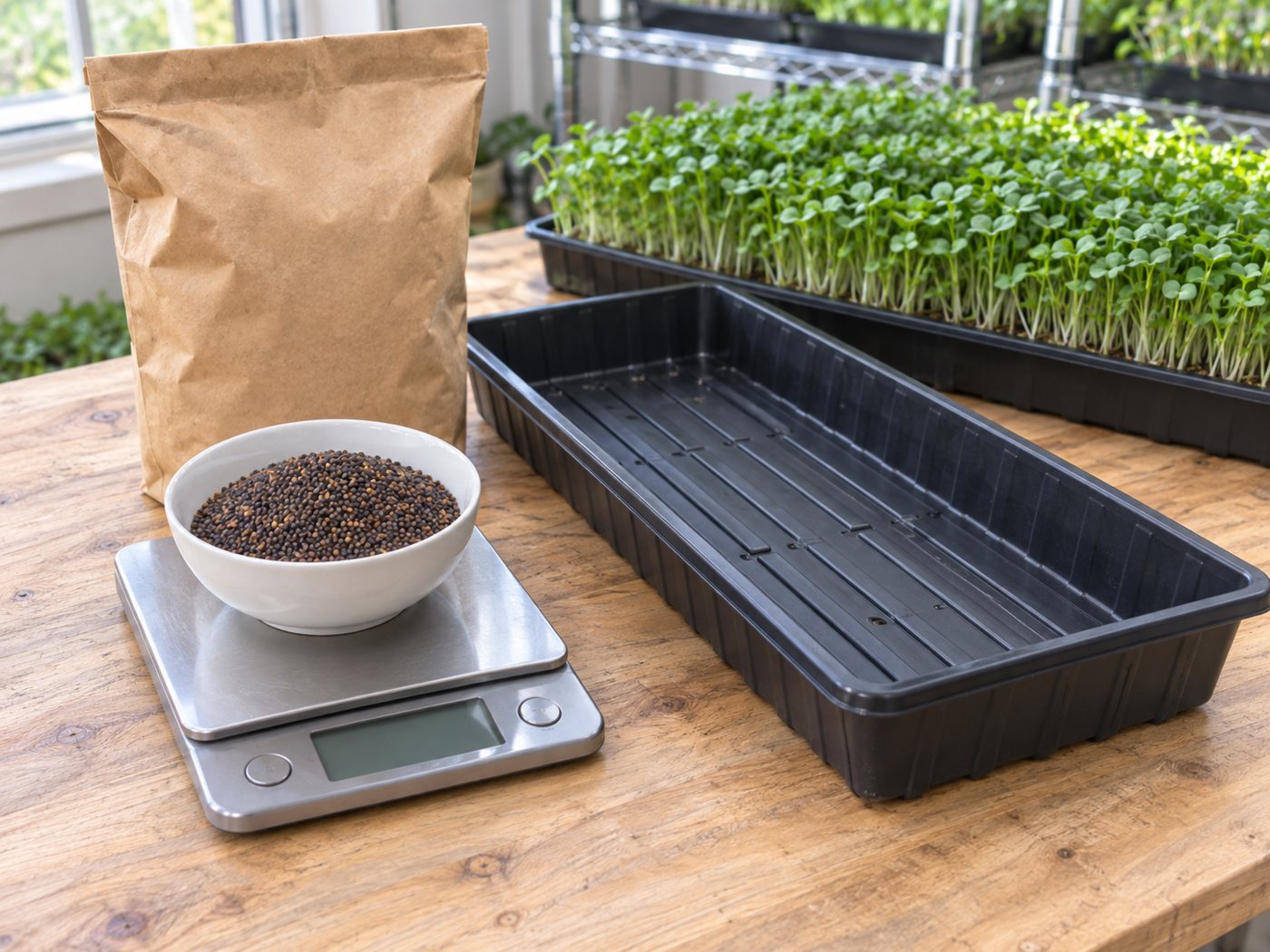
Microgreen Seed Density Chart for a 1020 Tray
This microgreen seed density chart lists a starting seed weight for one 1020 tray, roughly 200 square inches of growing area. Seed counts are calculated from the seeds per ounce on each of our product pages, so they are estimates; seed size varies from lot to lot.
| Crop | Seed per 1020 tray | Rate source | Approx. seeds per tray | Approx. seeds per sq in |
|---|---|---|---|---|
| Arugula | 10 g (0.35 oz) | USU | 4,940 | 25 |
| Broccoli | 28 g (0.99 oz) | USU | 8,890 | 44 |
| Red Russian Kale | 28 g (0.99 oz) | USU (kale) | 7,410 to 8,790 | 37 to 44 |
| Red Acre Cabbage | 25 g (0.88 oz) | Todd’s (20-25 g) | 6,610 to 7,500 | 33 to 37 |
| Rambo Radish | 42 g (1.48 oz) | USU (radish) | 3,700 to 4,440 | 19 to 22 |
| Daikon Radish | 42 g (1.48 oz) | USU (radish) | 2,960 to 3,700 | 15 to 19 |
| Cilantro, Split | 28 g (0.99 oz) | USU (cilantro) | 1,980 to 2,470 | 10 to 12 |
| Green Pea | 150 g (5.29 oz) | USU, 6 h soak | 530 to 1,060 | 3 to 5 |
Two things stand out. First, rates are given by weight, not volume, because a tablespoon of small seed can vary by several grams depending on how it settles. Second, seed count per square inch varies a lot by crop. Broccoli at 28 grams works out to about 44 seeds per square inch, while radish at 42 grams is closer to 20, because each radish seed is so much larger.
How to Read a Microgreen Seed Density Chart
Any microgreen seed density chart is a baseline, not a rule. Utah State’s rates are on the dense side, which suits growers who sell by weight. Penn State Extension describes a wider range of about 2 seeds per square inch for large seeds up to 12 per square inch for small seeds, which produces sturdier, more open trays. The University of Maryland Extension suggests about 1 tablespoon, or 10 to 15 grams, of small seed per 10 x 20 flat, which is closer to the light end of the range.
If you are new to a crop, start in the middle, weigh exactly, and write the rate on the tray tag. After two or three harvests you will know whether to go up or down.
Growing Times That Go With the Chart
Seed density and timing work together. A dense tray that stays covered too long can stretch and yellow, while a light tray uncovered too early may not root well. These timings come from Utah State University Extension, which grows at about 74°F for germination, 72°F with lights on and 68°F with lights off, under 18 hours of light per day.
| Crop | Pre-soak | Covered (blackout) | Days to harvest |
|---|---|---|---|
| Arugula | None | 1 to 2 days | 6 to 8 days |
| Broccoli | None | 2 to 4 days | 8 to 12 days |
| Kale | None | 1 to 2 days | 8 to 12 days |
| Radish | None | 1 to 2 days | 8 to 12 days |
| Cilantro | None | 7 to 14 days | 21 to 28 days |
| Pea | 6 hours | 3 days | 8 to 10 days |
Utah State covers newly sown trays with a second tray and a 2 to 5 pound weight. The weight presses seed into the media, helps roots anchor, and encourages an even stand, which matters more at high seeding rates.
Adjust Seed Density for Germination Rate
A chart rate assumes most of your seed sprouts. If a lot tests lower, you need more seed to get the same stand. Penn State Extension gives a simple way to calculate it:
- Pick a target density. Decide how many plants you want per square inch.
- Multiply by tray area. Target density x 200 square inches = plants needed per tray.
- Divide by germination rate. Plants needed ÷ germination (as a decimal) = seeds to sow.
- Convert to grams. Seeds to sow ÷ seeds per gram = grams of seed per tray.
Worked Example: Using the Microgreen Seed Density Chart for Broccoli
Say you want 30 broccoli plants per square inch and your lot germinates at 90 percent. That is 30 x 200 = 6,000 plants. Divide by 0.90 to get about 6,667 seeds. Our broccoli runs about 9,000 seeds per ounce, or roughly 317 seeds per gram, so you would sow about 21 grams. Push the target to 44 plants per square inch and you are back near Utah State’s 28 gram rate.
This is why a germination number on the lot matters. A 10 point drop in germination means about 11 percent more seed for the same tray. Every lot of Todd’s Seeds bulk broccoli seed is lab tested for germination and purity, so you can plug a real number into the formula instead of guessing.
Weighing Seed Accurately
Volume scoops are fast, but they drift. Small seeds pack differently depending on humidity and how the bag was handled, and the error adds up over hundreds of trays. A scale that reads to 0.1 gram lets you hit the same rate every time, check a new lot’s seed size, and track exactly how much seed each crop uses.
A simple routine: tare a small cup, weigh one tray’s worth, and pour it into a shaker or your hand to spread. For crops you sow often, weigh a batch into labeled cups at the start of the day.
Recommended Tool: Precision Kitchen Scale
BOMATA Large Kitchen Scale, 0.1 g Resolution, 11 lb Capacity
Reads in 0.1 gram steps up to 11 pounds, so it handles a 10 gram arugula tray and a 150 gram pea tray, or a full tub of seed when you check what is left in a bag. The large platform fits a seed cup or a small tray, and it is an Amazon’s Choice pick with thousands of ratings.
As an affiliate, Todd’s Seeds may earn a commission from qualifying purchases made through this link, at no extra cost to you.
Spreading Seed Evenly
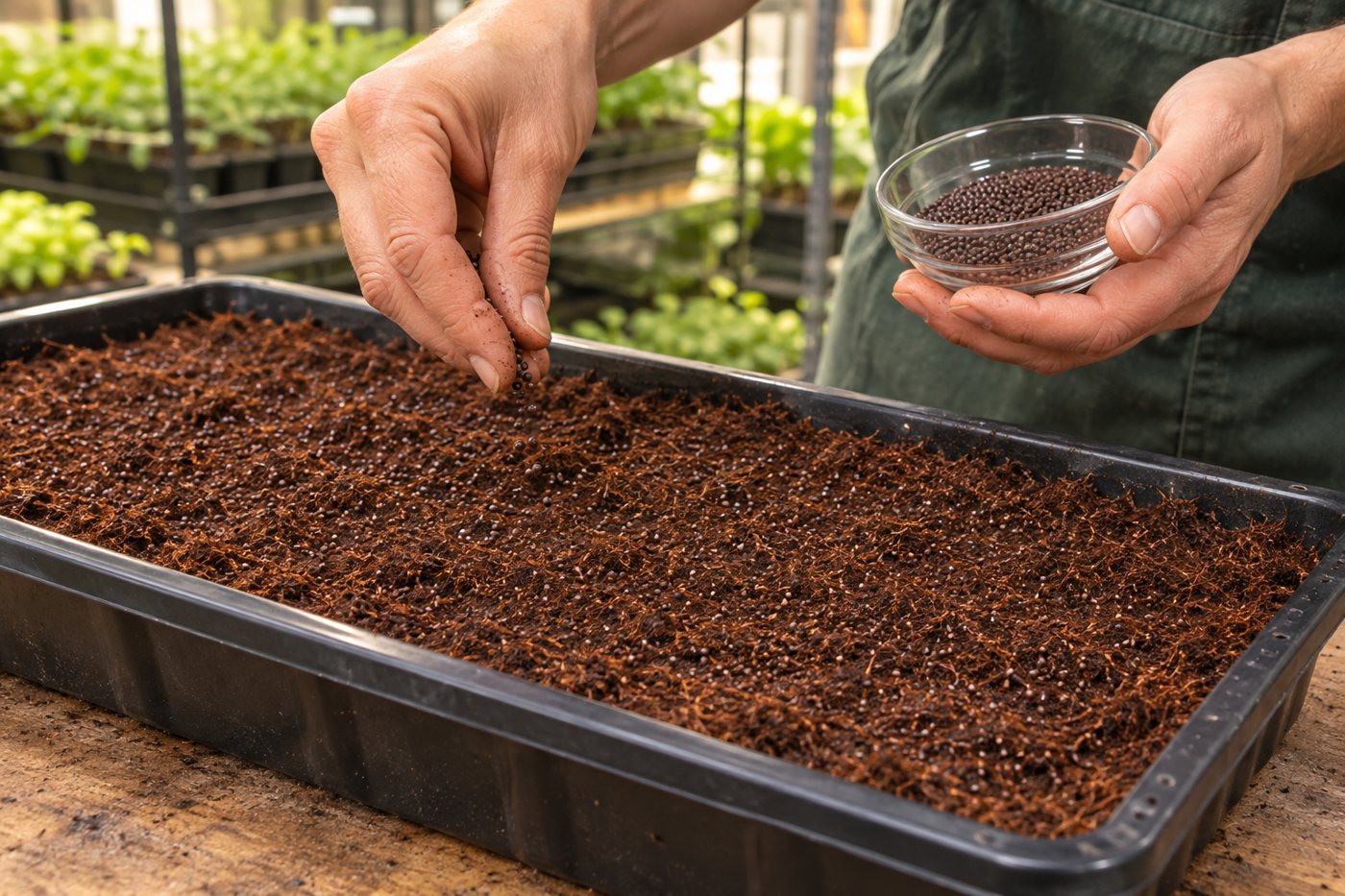
Even coverage is as important as the total weight. Thin spots waste tray space and thick clumps hold moisture, which can lead to mold. A few habits help:
- Pre-moisten the growing media so seed stays where it lands.
- Sow in two passes, half the seed lengthwise and half crosswise.
- Use a seed shaker or a cup with small holes for tiny seed such as arugula.
- Mist the surface after sowing, then cover and weight the tray.
- For peas and other large seed, soak first, then spread in a single layer with seeds just touching.
For crop-by-crop sowing steps with photos, see The Ultimate Guide to Growing Microgreen Seeds on our main site.
Trays Per Bag and Seed Cost Per Tray
Once you know the rate, you can plan purchases by trays instead of pounds. A 5 pound bag holds about 2,268 grams and a 20 pound order, which usually ships as four 5 pound bags, about 9,072 grams. The table below uses the same rates as the microgreen seed density chart above and the current bulk prices on this site.
| Crop | Rate | Trays per 5 lb | Trays per 20 lb | Seed cost per tray (5 lb) | Seed cost per tray (20 lb) |
|---|---|---|---|---|---|
| Arugula | 10 g | 227 | 907 | $0.18 | $0.16 |
| Broccoli | 28 g | 81 | 324 | $0.84 | $0.66 |
| Red Russian Kale | 28 g | 81 | 324 | $0.69 | $0.54 |
| Red Acre Cabbage | 25 g | 91 | 363 | $0.64 | $0.56 |
| Rambo Radish | 42 g | 54 | 216 | $2.44 | $2.04 |
| Daikon Radish | 42 g | 54 | 216 | $0.45 | $0.35 |
| Cilantro, Split | 28 g | 81 | 324 | $0.37 | $0.32 |
| Green Pea | 150 g | 15 | 60 | $0.53 | $0.42 |
At 28 grams per tray, a 20 pound bag of broccoli sows about 324 trays for roughly $0.66 of seed each. That is a useful number when you set prices for restaurants or farmers market customers. Our microgreens business plan walks through the rest of the cost side.
Rambo radish is the outlier. It is a premium purple seed, so a dense 42 gram tray costs more, and many growers sow it a little lighter or mix it with daikon radish to stretch the bag. Pea shoots, on the other hand, use a lot of seed by weight but cost very little per tray from bulk green pea seed.
When to Go Lighter or Denser
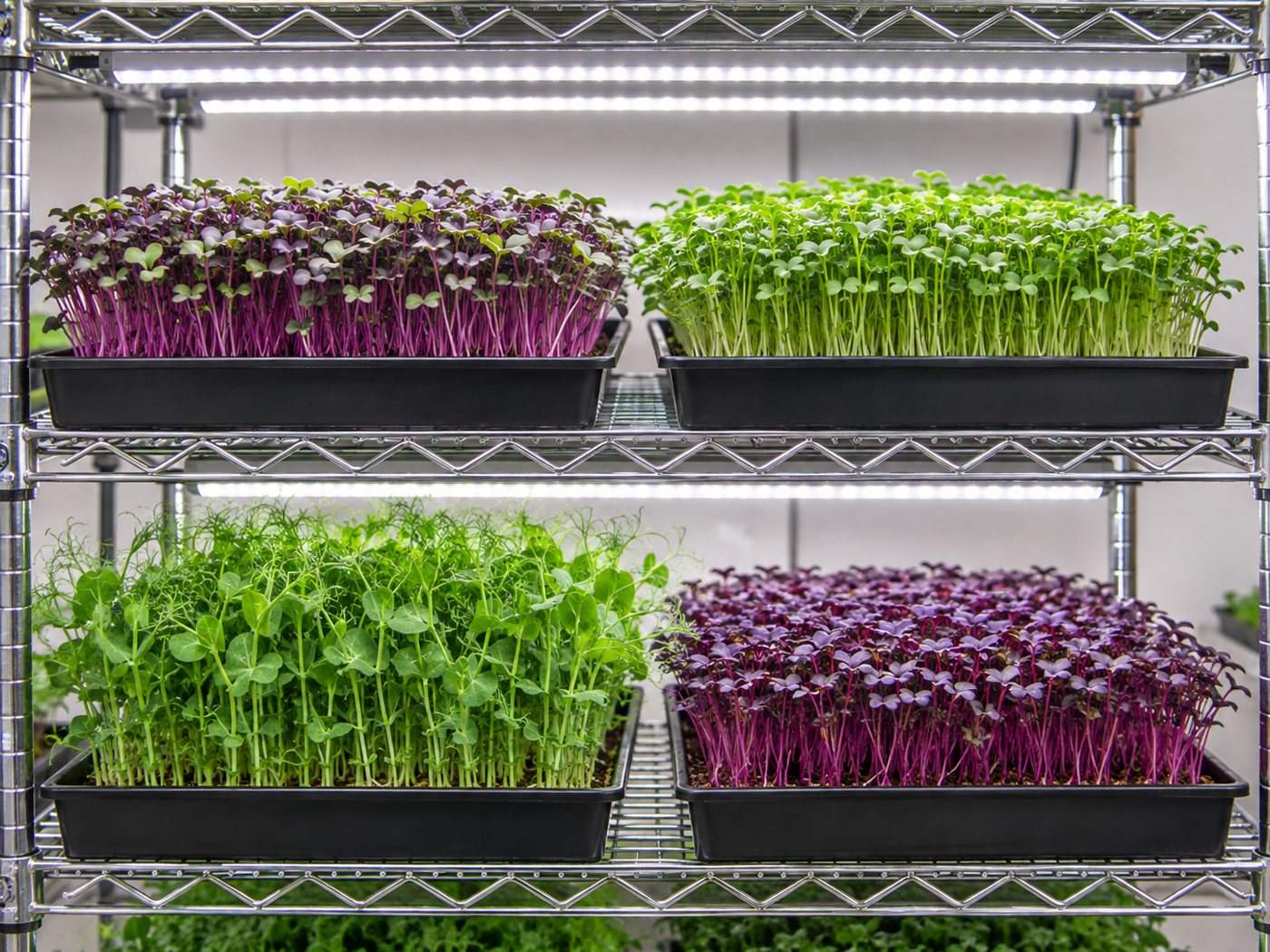
No microgreen seed density chart can account for every grow room. Adjust from the baseline based on what you see:
- Go lighter if you see mold at the base, damping off, weak yellow stems, or uneven height. Lower density improves airflow.
- Go lighter for crops you harvest larger or later, such as cilantro at 21 to 28 days.
- Go denser if trays look patchy at harvest and you sell by weight.
- Go denser only if your airflow, watering and sanitation can keep up.
- Retest whenever you switch seed lots, media or tray type, since seed size and germination change.
Not sure which crops to start with? Our overview of different types of microgreens covers flavor, color and growing time for the most popular varieties.
Food Safety for Microgreen Growers
Microgreens are often eaten raw, so treat them like fresh produce. Start with clean trays and fresh growing media, water from below when you can, harvest above the media line with clean tools, and refrigerate promptly. If you also grow these seeds as sprouts in jars or sprouters, the warm, humid conditions that sprout seeds also favor bacterial growth. The FDA advises that children, older adults, pregnant women and people with weakened immune systems avoid raw or lightly cooked sprouts of any kind, and that cooking sprouts thoroughly reduces the risk.
Bulk Seed for Your Seeding Rates
Whatever rate you settle on from the microgreen seed density chart, buying by the pound keeps cost per tray down. Every bulk bag from Todd’s Seeds is non-GMO, untreated seed, lab tested for germination and purity, with a lot number on every bag. Most orders ship in 5 pound bags, so a 20 pound order usually arrives as four 5 pound bags. Choose from broccoli, arugula, Red Russian kale, Red Acre cabbage, Rambo radish, split cilantro and more in 5, 10 and 20 pound sizes. See our free shipping details or browse the full bulk seed shop.
Microgreen Seed Density FAQ
What is a microgreen seed density chart?
A microgreen seed density chart lists how much seed, usually in grams, to sow on a standard tray for each crop. It gives growers a repeatable starting rate that they adjust for germination, seed size and how dense they want the finished tray.
How much seed do I need for a 1020 tray of microgreens?
Most small-seeded crops such as broccoli, kale and cabbage need about 25 to 28 grams per 1020 tray. Arugula needs about 10 grams, radish about 42 grams, and peas about 150 grams or more, based on Utah State University Extension rates.
How many seeds per square inch should I sow for microgreens?
Penn State Extension describes about 2 seeds per square inch for large seeds up to 12 for small seeds. Denser commercial rates are common; broccoli at 28 grams per tray works out to roughly 44 seeds per square inch.
Should I measure microgreen seed by weight or volume?
Weight is more accurate. A tablespoon of small seed can vary by several grams depending on how it settles, so weighing with a 0.1 gram scale gives repeatable trays.
How do I adjust seeding rate for germination?
Divide the number of plants you want by the germination rate as a decimal. If you want 6,000 plants and the seed germinates at 90 percent, sow about 6,667 seeds, then convert to grams using seeds per gram.
How many trays does a 5 pound bag of broccoli seed sow?
At 28 grams per tray, a 5 pound bag of broccoli seed sows about 81 trays and a 20 pound bag sows about 324 trays.
Does seeding too densely cause mold?
Overly dense trays hold moisture at the base and restrict airflow, which raises the risk of mold and damping off. If you see it, lower your seeding rate and improve airflow and drainage.
Sources
The rates in this microgreen seed density chart are drawn from the following extension and government resources:
[…] sprouting seeds for chickens also work for wheatgrass and microgreens. If you grow those too, our microgreen seed density chart and microgreen yield per tray guide cover seeding rates and harvest weights, and our main site […]