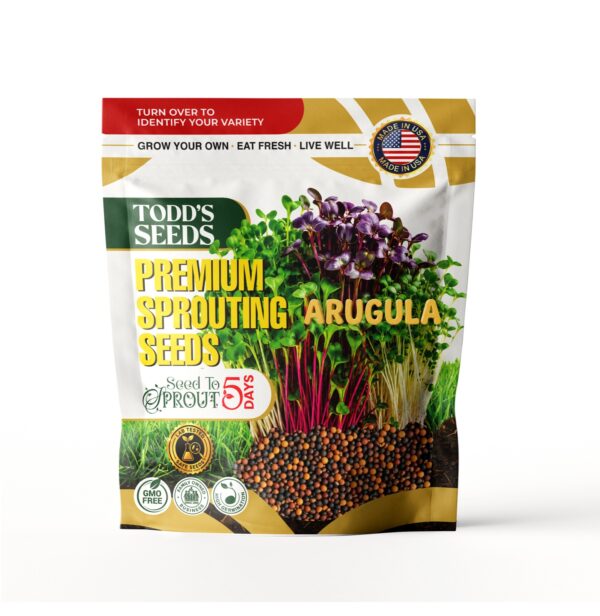
Peppery arugula for sprouts and microgreens. Fast, uniform germination and strong flavor.
General Description
Arugula microgreens taste like a concentrated version of the salad green: nutty, peppery and bright. The tiny seedlings have notched, deep green leaves on tender stems and are ready to cut in about a week and a half.
Arugula is a mucilaginous seed, which means it forms a gel coating when wet. That gel makes it tricky in a jar but ideal on soil or a grow mat, where it sticks in place and germinates evenly. Do not presoak it.
Seed Facts
Latin Name
Eruca vesicaria subsp. sativa
Type
Open Pollinated, Cool Season
Life Cycle
Annual
USDA Zones
2, 3, 4, 5, 6, 7, 8, 9, 10, 11 (grown as an annual)
Seeds per Ounce
Approx. 14,000
Planting Method
Microgreen Tray or Direct Sow (do not presoak)
Sunlight
Full Sun to Part Shade
Height
12 to 24 Inches (mature plant); microgreens 2 to 3 Inches
Color
Green; cream flowers with purple veins
Bloom Season
Blooms Late Spring, Blooms Early Summer
Uses
Microgreens, Salad Greens, Culinary
Seeds per ounce is an approximate average from published extension and USDA seed tables; actual counts vary from lot to lot.
Nutritional Value
No official USDA nutrient profile exists for arugula microgreens or sprouts specifically. Like other young brassicas (the cabbage family), they supply vitamin C, vitamin K, folate and fiber, along with the natural sulfur compounds called glucosinolates that give the family its sharp, peppery bite.
Mature raw arugula is a good source of vitamin K, folate, calcium and vitamin A according to USDA FoodData Central (FDC ID 169387). The USDA Agricultural Research Service found that microgreens as a group averaged about five times the vitamin and carotenoid levels of mature leaves, though results vary by crop.
Ways to Use
Finish pizzas and flatbreads right out of the oven
Add a peppery layer to sandwiches, burgers and wraps
Mix with milder greens in salads
Garnish soups, eggs, pasta and risotto
Blend into pesto with basil or on its own
General Growing Instructions (Microgreens)
Fill a 10×20 inch tray with about an inch of moist potting mix or a pre-wet grow mat.
Spread about 1/2 ounce (about 15 grams) of seed evenly across the surface and mist well.
Cover or stack another tray on top for 2 to 4 days of blackout to encourage even germination and strong stems.
Uncover once most seeds have rooted, move to bright light and bottom water as needed.
Harvest with clean scissors just above the soil line in about 8 to 12 days.
Arugula seed gels when wet, so sow it dry and mist it rather than soaking.
Video: “Growing Microgreens – How to Grow Garden Cress and Arugula Microgreens” by Khang Starr on YouTube.
Recommended Sprouting Gear
Heavy-Duty 1020 Mesh Trays (10 Pack)
A 10-pack of extra-strength 10×20 inch trays with mesh drainage holes. Use them with soil or a grow mat, nest one inside a solid tray for bottom watering, or stack them to weigh down seeds during germination. They are sturdy enough to wash and reuse batch after batch. Arugula’s gel-coated seed grows best on a mat or soil rather than in a jar.
As an affiliate, Todd’s Seeds may earn a commission from qualifying purchases made through this link, at no extra cost to you.
Food Safety
If you grow these seeds as sprouts in a jar or sprouter, treat them like any raw sprout: the warm, humid conditions that sprout seeds also favor bacterial growth. The FDA advises that children, older adults, pregnant women and people with weakened immune systems avoid raw or lightly cooked sprouts of any kind. For microgreens and shoots, use clean trays and fresh growing media, water from below when you can, harvest above the soil line and refrigerate promptly.
Bulk sizes
Available in 5, 10 and 20 pound sizes. Orders usually ship in 5 lb bags, so a 10 lb size typically arrives as two 5 lb bags and a 20 lb size as four 5 lb bags, each labeled with its lot number. Repacked into Todd’s Seeds branded packaging at our Cookeville, Tennessee facility and shipped direct to you.
Every lot
Non-GMO, untreated seed
Lab tested for germination and purity
Lot numbers traceable on every bag
Shipping calculated by live carrier rates from Tennessee